
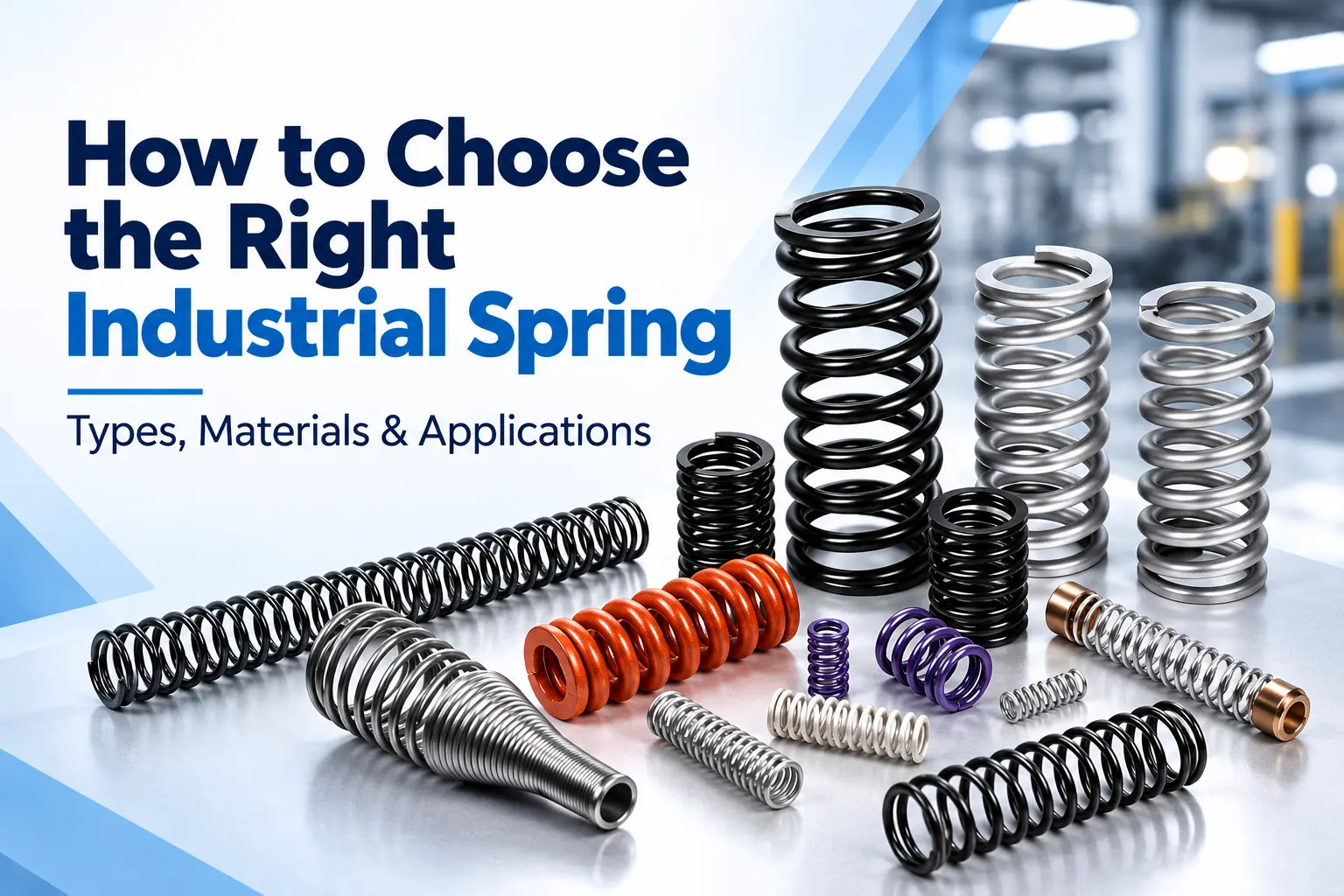
Industrial springs are essential components in machinery, automotive systems, electrical equipment, construction tools, and numerous manufacturing processes. Although springs are often small components, their performance directly affects equipment efficiency, stability, durability, and operational safety.
Choosing the right spring requires more than selecting a suitable size. Factors such as load capacity, material strength, operating conditions, spring design, and expected service life all play an important role.
Spring Manufacturing Co. provides a range of industrial spring solutions, including compression springs, tension springs, torsion springs, disc springs, helical springs, and customized springs designed for different industrial requirements. Understanding the available options can help businesses select components that match their machinery and production needs.
Why Is Choosing the Right Industrial Spring Important?
Industrial springs store and release mechanical energy, absorb shocks, maintain tension, and control movement. Selecting an unsuitable spring can lead to premature wear, inconsistent machine performance, frequent maintenance, and unexpected equipment downtime.
The right spring helps businesses achieve several operational benefits:
- Reliable performance: Springs designed for the intended load and operating conditions deliver consistent mechanical support.
- Reduced maintenance: Suitable materials and spring designs can minimize premature wear and replacement frequency.
- Improved equipment efficiency: Proper spring selection supports smoother movement, vibration control, and load management.
- Longer service life: Springs designed for repeated loading can provide dependable performance over extended operating periods.
- Application-specific functionality: Customized springs can accommodate unique dimensions, load requirements, and installation constraints.
For manufacturers and industrial equipment operators, selecting springs according to actual application requirements is an important part of maintaining productivity.
Types of Industrial Springs and Their Applications
Different spring designs perform different mechanical functions. Understanding these differences helps businesses identify the most appropriate solution for their equipment.
1. Compression Springs
Compression springs resist compressive forces and return toward their original shape when the applied load is removed. They are commonly used in automotive components, industrial machinery, valves, switches, and mechanical assemblies.
These springs are suitable for applications that require cushioning, controlled movement, or resistance against compression.
2. Tension Springs
Tension springs, also known as extension springs, operate under pulling forces. They are designed to stretch when a load is applied and return toward their original length when the load is released.
Common applications include garage doors, agricultural machinery, industrial mechanisms, and various mechanical assemblies.
3. Torsion Springs
Torsion springs generate rotational force when twisted. They are useful in applications that require rotational movement or controlled return action.
Examples include hinges, clips, counterbalance mechanisms, automotive components, and certain industrial equipment.
4. Helical Springs
Helical springs are manufactured by winding wire into a helical shape. Depending on their design, they can perform compression, extension, or torsional functions.
Their versatility makes them suitable for a wide range of mechanical systems, from general industrial machinery to specialized equipment.
5. Disc Springs
Disc springs, also known as Belleville springs, have a conical disc shape and can provide relatively high force within a compact space.
They are used in bolted assemblies, industrial machinery, clamping systems, and applications where controlled force and limited installation space are important.
6. Customized Industrial Springs
Standard spring designs may not always satisfy specific equipment requirements. Customized springs can be developed according to application needs, including dimensions, wire diameter, material, load characteristics, and working environment.
Spring Manufacturing Co. (SpringMFG) offers multiple spring categories and customized solutions to help businesses identify suitable products for their operational requirements.
Key Factors to Consider When Selecting an Industrial Spring
Before purchasing industrial springs, businesses should evaluate the following technical factors.
Load and Force Requirements
Determine the force the spring must support, generate, or resist. Compression, tension, and torsion applications require different design considerations.
The spring must operate within its intended working limits to reduce the risk of permanent deformation or premature failure.
Material Selection
Material selection influences spring strength, fatigue resistance, corrosion resistance, and performance under different temperatures.
Common material options include carbon spring steel, alloy steel, and stainless steel. The appropriate choice depends on the application, environmental conditions, and required mechanical properties.
Dimensions and Available Space
Wire diameter, outer diameter, free length, number of coils, and installation space can affect spring performance.
Accurate measurements and engineering specifications help ensure that the spring fits correctly and functions as intended.
Operating Environment
Springs used in humid, corrosive, high-temperature, or high-vibration environments may require specific materials or protective finishes.
Understanding the operating environment helps manufacturers recommend appropriate designs and material options.
Fatigue Life and Durability
Many industrial springs undergo repeated loading and unloading cycles. The expected number of cycles, operating stress, and working conditions should be considered during the design process.
A spring designed for repeated operation can help reduce unexpected breakdowns and replacement costs.
How Spring Manufacturing Co. Supports Industrial Requirements
Selecting a suitable spring manufacturer is an important consideration for businesses that require consistent components for machinery and equipment.
Spring Manufacturing Co. has been operating since 1974 and serves customers across India, with export capabilities. Based in Howrah, West Bengal, the company offers a broad range of spring products for different mechanical and industrial applications.
Its product portfolio includes compression springs, helical springs, tension springs, torsion springs, disc springs, wire forming springs, spring washers, die springs, conical springs, and stainless steel springs.
The company also provides customized spring solutions for applications requiring specific dimensions and design requirements.
When evaluating a supplier, businesses should discuss technical drawings, material specifications, expected loads, operating cycles, required quantities, and delivery schedules. Sharing these details helps establish whether the proposed spring meets the application’s requirements.
Industries That Depend on Industrial Springs
Industrial springs support numerous sectors where controlled movement, mechanical force, and vibration management are essential.
- Automotive: Suspension systems, mechanical assemblies, and selected engine components.
- Manufacturing: Production machinery, automated equipment, and mechanical control systems.
- Construction: Industrial tools, equipment mechanisms, and heavy machinery assemblies.
- Agriculture: Agricultural implements, operating mechanisms, and equipment components.
- Electrical equipment: Switches, connectors, and other mechanisms requiring controlled spring force.
- General engineering: Fixtures, fasteners, machinery assemblies, and specialized mechanical equipment.
Each application has different requirements. Working with an experienced manufacturer helps businesses assess spring type, material, dimensions, and load characteristics before placing an order.
Frequently Asked Questions
1. What are industrial springs used for?
Industrial springs store and release energy, absorb shocks, maintain tension, control movement, and support mechanical loads. They are used in automotive systems, manufacturing machinery, construction equipment, agricultural implements, and electrical devices.
2. Which type of industrial spring should I choose?
The right type depends on how the spring will operate. Compression springs resist pushing forces, tension springs operate under pulling forces, torsion springs generate rotational force, and disc springs provide high force in a compact design. Application requirements should guide the final selection.
3. What materials are commonly used to manufacture industrial springs?
Carbon spring steel, alloy steel, and stainless steel are common options. The selection depends on the required strength, fatigue performance, corrosion resistance, operating temperature, and surrounding environment.
4. Does Spring Manufacturing Co. offer customized springs?
Spring Manufacturing Co. lists customized springs among its product offerings. Customers can discuss their requirements, including dimensions, material preferences, drawings, expected loads, and intended applications, to determine a suitable solution.
Conclusion
Choosing the right industrial spring is essential for reliable machinery performance, efficient operations, and long-term equipment durability. Businesses should evaluate spring type, material, load capacity, dimensions, operating environment, and fatigue requirements before making a purchasing decision.