
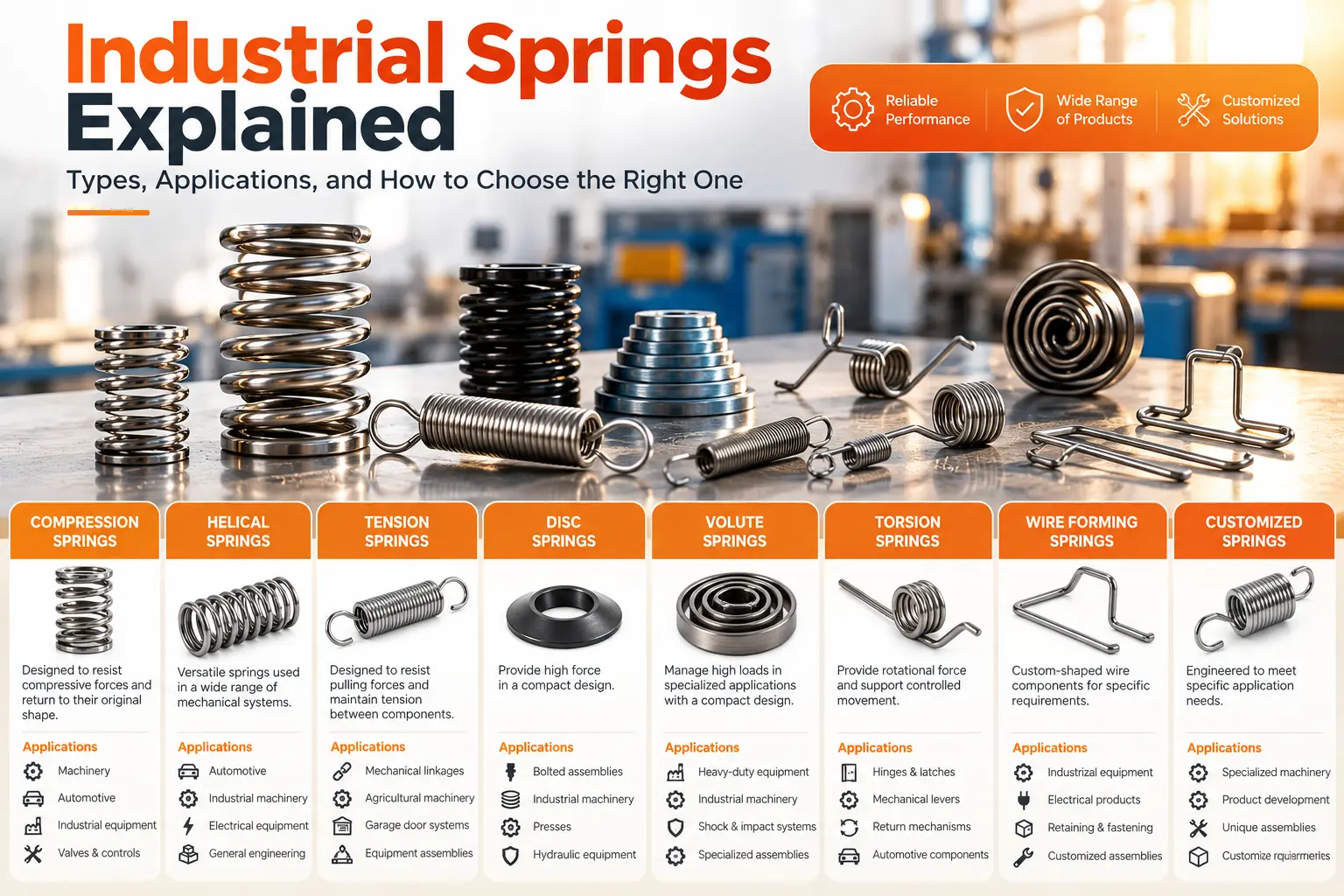
Industrial springs are essential components in countless mechanical systems. From heavy machinery and automotive assemblies to electrical equipment and manufacturing tools, springs help manage forces, absorb energy, control movement, and maintain mechanical stability.
However, not every spring serves the same purpose. Some are designed to resist compression, others maintain tension, while specialized designs provide rotational force or support high loads within limited spaces.
Selecting the appropriate spring can make a significant difference to equipment performance, component compatibility, and maintenance requirements. Understanding the different types of industrial springs helps engineers, manufacturers, and procurement professionals make better purchasing decisions.
In this guide, we explore the most common industrial spring types, their applications, and the factors to consider when sourcing springs for your business.
1. Compression Springs: Designed to Resist Compressive Forces
Compression springs are among the most widely used industrial spring types. They are designed to resist a compressive force and return toward their original shape when the load is removed, provided they remain within their intended operating limits.
Typically manufactured as open coils, these springs store mechanical energy when compressed and release it as they expand.
Common applications
Compression springs are used in:
- Automotive and mechanical assemblies.
- Industrial machinery and equipment.
- Valves and control mechanisms.
- Switches and electrical devices.
- Shock absorption and cushioning systems.
Why choose compression springs?
Compression springs are suitable for applications requiring controlled resistance to compressive forces. Their dimensions, wire diameter, coil geometry, and material can be selected according to the required load and available space.
For applications with specific load or dimensional requirements, a customized compression spring may be more suitable than a standard design.
2. Helical Springs: Versatile Solutions for Mechanical Systems
Helical springs are manufactured by winding wire into a coil or helix. Depending on their design, they can function as compression springs, tension springs, or torsion springs.
Their versatility makes them suitable for a broad range of mechanical applications.
Common applications
Helical springs may be used in:
- Automotive suspension and mechanical assemblies.
- Industrial presses and machinery.
- Clamping and control mechanisms.
- Electronic equipment.
- General engineering applications.
Why choose helical springs?
Helical spring designs can be adapted to different loading conditions and functional requirements. Their performance depends on factors such as wire diameter, coil diameter, number of active coils, material properties, and the intended direction of loading.
Businesses should define the required spring rate, working load, travel, and installation dimensions before selecting a suitable design.
3. Tension Springs: Maintaining Force Between Components
Tension springs, also known as extension springs, are designed to resist pulling forces. When extended, they generate a restoring force that helps bring connected components back toward their original positions.
These springs often incorporate hooks or loops at their ends to connect with surrounding components.
Common applications
Tension springs are used in:
- Industrial linkages and mechanical assemblies.
- Agricultural machinery.
- Garage door mechanisms.
- Equipment with tension-controlled movement.
- Various automotive and general engineering applications.
Why choose tension springs?
Tension springs are useful when components need to remain connected under a pulling force or return to a defined position after movement.
When choosing a tension spring, consider the initial tension, working extension, maximum load, end configuration, and expected number of operating cycles.
For specialized requirements, discuss the application with a manufacturer to determine suitable dimensions and material properties.
4. Disc Springs: High Force in a Compact Design
Disc springs, also known as Belleville springs, have a conical disc shape that allows them to provide substantial force within a compact space.
They are particularly useful in assemblies where conventional coil springs may not provide the required load characteristics or fit within the available dimensions.
Common applications
Disc springs are used in:
- Industrial clamping systems.
- Heavy machinery and mechanical assemblies.
- Bolted connections requiring maintained preload.
- Presses and selected hydraulic equipment.
- Applications requiring compact spring arrangements.
Why choose disc springs?
Disc springs can deliver relatively high loads with limited deflection. Multiple discs may also be arranged in series or parallel to modify the load and travel characteristics, provided the arrangement is properly designed.
Material, thickness, disc geometry, operating stress, and fatigue requirements should be evaluated before selecting a disc spring.
5. Volute Springs: Managing High Loads in Specialized Applications
Volute springs are formed from strip material wound into a tapered, conical spiral. Their geometry allows successive turns to nest within one another as the spring compresses.
This design can be useful in applications requiring substantial compressive loads and specialized space or travel characteristics.
Common applications
Depending on the design, volute springs may be considered for:
- Heavy-duty mechanical equipment.
- Industrial machinery.
- Shock and impact management systems.
- Specialized load-bearing assemblies.
Why choose volute springs?
Their tapered construction provides different operating characteristics from conventional cylindrical coil springs. The appropriate design depends on the required load, available travel, mounting arrangement, material, and operating environment.
For demanding applications, engineering assessment is important to confirm that the spring meets the expected mechanical requirements.
6. Torsion Springs: Supporting Rotational Movement
Torsion springs are designed to generate torque when rotated through an angle. Rather than primarily resisting axial compression or extension, they provide a restoring moment that supports rotational movement.
They are commonly manufactured as coils with legs or arms that transfer the applied torque to the surrounding assembly.
Common applications
Torsion springs may be used in:
- Hinges and latches.
- Mechanical levers.
- Return mechanisms.
- Industrial control assemblies.
- Selected automotive and equipment components.
Why choose torsion springs?
Torsion springs are suitable when a mechanism requires controlled rotational force or automatic return movement.
Key selection factors include the required torque, angular travel, coil dimensions, leg configuration, mounting arrangement, and operating cycle requirements.
The spring should be designed for the actual direction and magnitude of loading expected in the application.
7. Wire Forming Springs: Custom Shapes for Specific Requirements
Not every industrial application can be addressed with a conventional coiled spring. Wire forming springs and related formed-wire components can be shaped into specific configurations to suit particular assembly requirements.
Depending on their design, these components may provide spring action, retention, support, connection, or controlled flexibility.
Common applications
Wire formed components may be used in:
- Industrial equipment and machinery.
- Automotive assemblies.
- Electrical and electronic products.
- Retaining and fastening mechanisms.
- Specialized mechanical assemblies.
Why choose wire forming springs?
Custom wire forming can accommodate specific bends, hooks, loops, and three-dimensional geometries. This makes it useful when standard spring shapes cannot meet the available space or functional requirements.
When requesting a quotation, provide the component drawing or sample, wire diameter, material preference, dimensions, required function, and production quantity.
8. Customized Springs: Solutions Built Around Your Application
Standard springs are suitable for many applications, but some engineering requirements call for a more specific design.
Customized springs are developed according to the functional and dimensional needs of an assembly. Depending on the application, customization may involve spring type, material, wire diameter, coil geometry, load capacity, end configuration, or surface finishing.
When should you consider a customized spring?
A custom design may be appropriate when:
- Standard spring dimensions do not fit the assembly.
- The application requires a specific load or spring rate.
- Operating conditions differ from those of general-purpose applications.
- A specialized end configuration is necessary.
- The spring must fit into an existing or newly developed product.
What information should you provide?
To help a manufacturer assess your requirements, prepare the following wherever possible:
- Technical drawing or physical sample.
- Required dimensions and tolerances.
- Working load and deflection.
- Material and finishing preferences.
- Operating temperature and environmental conditions.
- Expected operating frequency.
- Required quantity and production schedule.
Providing clear specifications at the beginning can help establish manufacturing feasibility and reduce unnecessary design revisions.
How to Choose the Right Industrial Spring:
Choosing the right spring involves more than identifying its general type. The spring must perform reliably within the equipment’s actual operating conditions.
Consider these five factors before making a selection.
1. Type of Force
Determine whether the spring needs to resist compression, extension, or rotational movement. This helps narrow down the appropriate spring category.
2. Load and Deflection Requirements
Identify the force the spring must generate or withstand and the amount of movement required during operation.
An unsuitable spring rate or excessive deflection can affect performance and shorten service life.
3. Available Space
Measure the installation area and identify dimensional constraints. Consider the spring’s free length, working length, diameter, mounting arrangement, and clearance requirements.
4. Material and Operating Environment
Select materials based on mechanical requirements, temperature, moisture, chemical exposure, and corrosion risk.
The material and any surface treatment should be suitable for the intended environment.
5. Manufacturing Quality and Specifications
Confirm that the supplier can manufacture the required design to the agreed dimensional and performance specifications.
For critical applications, discuss inspection requirements, testing, traceability, and applicable industry standards before production.
Why Source Industrial Springs from Springmfg?
Spring Manufacturing Co. has been operating in the spring manufacturing industry since 1974 and supplies a broad range of industrial spring products to customers across India and export markets.
Its product portfolio includes compression springs, helical springs, tension springs, volute springs, disc springs, wire forming springs, torsion springs, spring washers, conical springs, die springs, stainless steel springs, and customized spring solutions.
This range allows businesses to explore different spring categories according to their mechanical requirements.
Whether you are sourcing springs for industrial machinery, developing a new product, or looking for a component with specific dimensions, clearly defining the application’s requirements is an important first step.
Visit the Springmfg product catalogue to explore available categories, or request a quotation for your spring requirements.
Frequently Asked Questions
1. Which types of industrial springs are most commonly used?
Compression springs, helical springs, tension springs, and torsion springs are widely used across mechanical and industrial applications. Disc springs, volute springs, and customized designs serve more specific requirements.
2. What is the difference between compression and tension springs?
Compression springs resist pushing forces and compress under load. Tension springs resist pulling forces and extend when the applied load overcomes their initial tension.
3. When are disc springs a suitable choice?
Disc springs are worth considering when an application requires relatively high force within a compact space. Their suitability depends on load, deflection, material, and operating conditions.
4. Can industrial springs be manufactured to custom specifications?
Yes. Custom spring designs can accommodate particular dimensions, loads, materials, and end configurations, subject to engineering feasibility and the manufacturer’s production capabilities.
5. How do I choose the right spring material?
Material selection depends on load requirements, fatigue demands, operating temperature, corrosion exposure, and the intended service life. Technical consultation can help identify appropriate options.
6. What details are needed to request a spring quotation?
Provide a drawing or sample if available, dimensions, material requirements, working load, deflection, quantity, operating conditions, and any specific quality requirements.
Conclusion
Industrial springs perform different functions depending on their design. Compression springs resist compressive loads, tension springs maintain force between connected components, torsion springs support rotational movement, and disc springs provide compact load-bearing solutions. Volute, wire forming, and customized springs address additional specialized requirements.
Understanding these differences helps businesses select components that suit their equipment and operating conditions.
If you are looking for industrial springs for manufacturing, engineering, or equipment applications, Springmfg offers a broad product range to explore.