
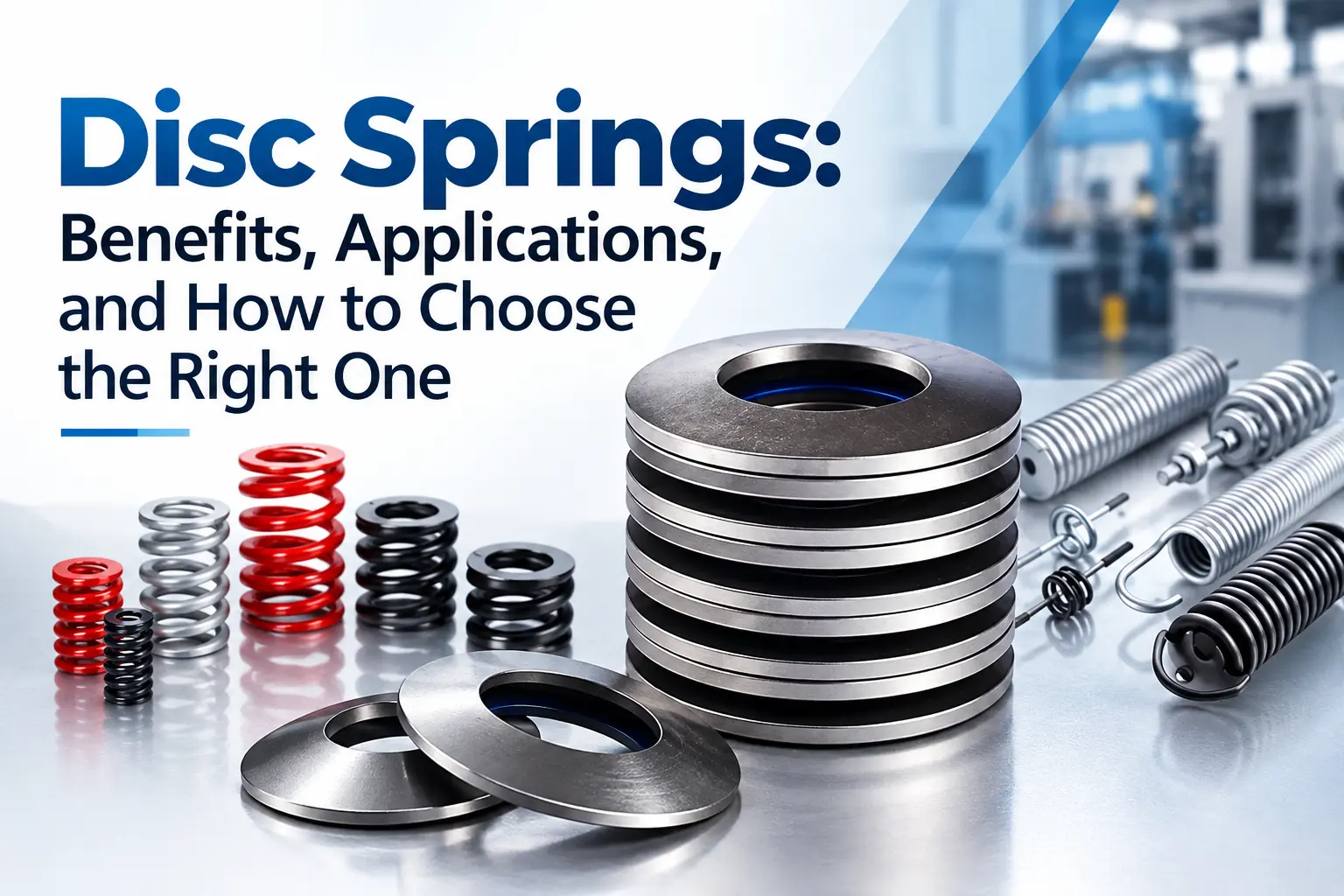
Disc springs are important mechanical components used in industrial systems where high force, controlled deflection, and compact design are essential. Unlike conventional helical springs, disc springs have a conical disc-shaped structure that allows them to support significant loads within a relatively small installation space.
From heavy machinery and automotive assemblies to industrial fastening systems, disc springs help maintain pressure, absorb mechanical loads, and support reliable equipment performance.
Spring Manufacturing Co. offers disc springs as part of its industrial spring product range, supporting businesses looking for spring solutions for different engineering and manufacturing applications.
In this guide, we explore how disc springs work, their key benefits, common applications, and the factors businesses should consider when selecting the right disc spring.
What Are Disc Springs?
A disc spring, also known as a Belleville spring, is a conical-shaped spring designed to deflect under an applied load and return toward its original shape when the load is removed, provided it operates within its design limits.
Its distinctive shape allows it to generate relatively high force over a short deflection distance. This makes disc springs particularly useful in applications where conventional coil springs may require more installation space.
Disc springs can also be arranged in different configurations to adjust their overall load and deflection characteristics according to application requirements.
Key Benefits of Disc Springs
1. High Load Capacity in a Compact Design
One of the main advantages of disc springs is their ability to support substantial loads without requiring a large amount of space. This makes them suitable for compact mechanical assemblies and heavy-duty industrial equipment.
2. Controlled Deflection
Disc springs can provide predictable force and deflection characteristics when properly designed and installed. This is useful in applications that require controlled movement or consistent clamping pressure.
3. Flexible Installation Configurations
Disc springs can be arranged in series, in parallel, or in combinations of both.
- Series arrangement: Increases the available deflection for a given load.
- Parallel arrangement: Increases the load capacity at a similar deflection.
- Combined arrangement: Allows engineers to balance load and deflection requirements.
The actual performance depends on the spring design, material, dimensions, and arrangement.
4. Support for Repeated Loading
When designed for the intended working conditions, disc springs can withstand repeated loading cycles. Proper material selection, stress management, and installation are essential for achieving the required service life.
5. Versatility Across Industrial Applications
Disc springs are used in numerous mechanical systems, including bolted joints, clamping assemblies, presses, valves, and heavy industrial equipment.
Their versatility makes them valuable wherever space constraints and controlled mechanical force are important considerations.
Common Applications of Disc Springs
Disc springs serve different purposes across industrial sectors. Some of their common applications include the following.
Automotive and Transportation
Disc springs can be used in selected automotive assemblies, clutches, braking mechanisms, and other systems requiring controlled spring force. The exact application depends on the vehicle design and engineering specifications.
Heavy Machinery and Manufacturing
Industrial presses, machine assemblies, and mechanical fastening systems may use disc springs to maintain force, accommodate movement, or support load management.
Bolted Joints and Fastening Systems
Disc springs can help maintain preload in bolted assemblies where movement, vibration, or changes in operating conditions may affect joint performance. Proper engineering is necessary to determine the appropriate configuration.
Valves and Mechanical Equipment
Certain valves and pressure-related mechanical systems use disc springs to provide controlled force within compact assemblies. Spring selection depends on the required operating characteristics and equipment design.
Power and Industrial Engineering
Disc springs may also be used in specialized industrial equipment where reliable mechanical loading, compact construction, and predictable deflection are required.
How to Choose the Right Disc Spring
Selecting a suitable disc spring involves evaluating several technical factors before placing an order.
1. Load Requirements
Determine the force the spring must support or generate during operation. The selected disc spring should meet the required load at the intended working deflection without exceeding its design limits.
2. Available Installation Space
Measure the available diameter and height of the installation area. Disc springs are particularly useful where space is limited, but accurate dimensions remain essential for proper fit and performance.
3. Material Selection
Material choice affects strength, fatigue performance, corrosion resistance, and operating temperature limits.
Carbon steel, alloy steel, and stainless steel may be suitable depending on the application. The correct material should be selected according to the working environment and required mechanical properties.
4. Operating Conditions
Consider temperature, moisture, corrosive exposure, vibration, and the frequency of loading cycles. These conditions can influence material selection, spring life, and the need for protective finishes.
5. Load and Deflection Characteristics
Understand the required relationship between applied force and spring deflection. Engineers should evaluate whether a single disc spring or a stacked configuration is appropriate for the intended performance.
6. Quality and Dimensional Accuracy
Consistent dimensions and appropriate material properties help ensure that a disc spring performs as expected. Ask your manufacturer about relevant specifications, inspection procedures, and testing requirements for your application.
Why Choose Spring Manufacturing Co. for Disc Springs?
Finding the right spring supplier is important for businesses that rely on dependable mechanical components.
Spring Manufacturing Co. has a manufacturing history dating back to 1974 and offers a broad range of industrial springs, including disc springs, compression springs, helical springs, tension springs, torsion springs, conical springs, die springs, and customized spring solutions.
The company serves customers across India and also exports its products.
When discussing a disc spring requirement with SpringMFG, businesses should share the intended application, required dimensions, load and deflection specifications, operating environment, and expected order quantity. Technical drawings or samples can also help clarify the requirements for a custom application.
Frequently Asked Questions:
1. What is the main purpose of a disc spring?
A disc spring provides spring force and controlled deflection within a compact space. It is commonly used in applications requiring high force, clamping pressure, or support for mechanical loads.
2. What is the difference between a disc spring and a coil spring?
A disc spring has a conical disc-shaped design and can generate relatively high force over a short deflection distance. A coil spring uses a helical wire structure and can be designed for compression, extension, or torsion. The appropriate choice depends on the available space and the application’s load and movement requirements.
3. Can disc springs be stacked together?
Yes. Disc springs can be stacked in series, in parallel, or in combined configurations. Series arrangements generally increase deflection, while parallel arrangements generally increase load capacity. Correct stacking and installation are essential for achieving the desired performance.
4. Which materials are used to manufacture disc springs?
Disc springs are commonly manufactured from spring steel, alloy steel, or stainless steel. The most appropriate material depends on load requirements, operating temperature, corrosion exposure, and fatigue-life expectations.
Conclusion
Disc springs are valuable components for industrial applications that demand high force, controlled deflection, and efficient use of space. Their adaptable configurations make them suitable for mechanical assemblies, fastening systems, heavy machinery, and other engineering applications.
Choosing the right disc spring requires careful consideration of load capacity, dimensions, material, operating conditions, and expected service life. Working with an experienced manufacturer can help businesses identify an appropriate solution for their specific requirements.
With its established manufacturing history and diverse industrial spring portfolio, Spring Manufacturing Co. supports businesses looking for disc springs and other spring solutions across different applications.